
Understanding the ROI formula is important for anyone involved in business, marketing, freelancing, or investing. Whether you run ads, invest money into a project, or start a small business, calculating ROI helps you understand if your investment is profitable or not.
Many beginners hear the term ROI but do not fully understand how it works. The good news is that the ROI formula is actually very simple. Once you understand the basics, you can easily measure profits, compare investments, and make smarter financial decisions.
In this guide, you will learn what ROI means, how the ROI formula works, how to calculate it step by step, and why businesses use ROI to measure success.
You can also use our free ROI Calculator to calculate ROI instantly without doing manual calculations.
What Is ROI?
ROI stands for Return on Investment. It is a financial metric used to measure how much profit or return you earn compared to the amount you invested.
In simple words, ROI tells you whether your investment was worth it or not.
Businesses use ROI to:
- measure marketing performance
- analyze business profits
- compare investments
- track advertising success
- evaluate project performance
For example, if you spend money on Facebook ads, Google ads, or a business campaign, ROI helps you understand how much profit you made from that investment.
ROI Formula Explained
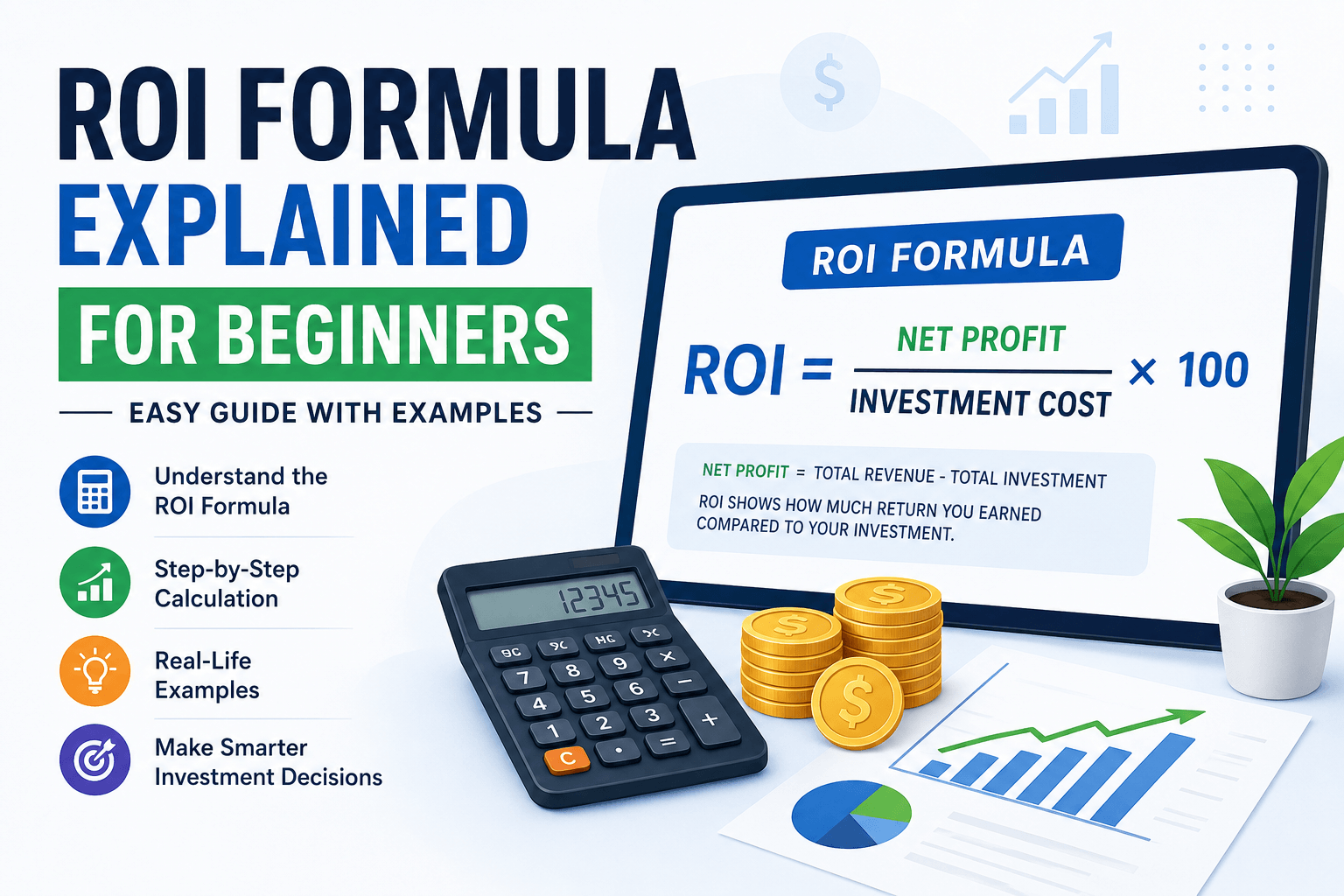
The standard ROI formula is:
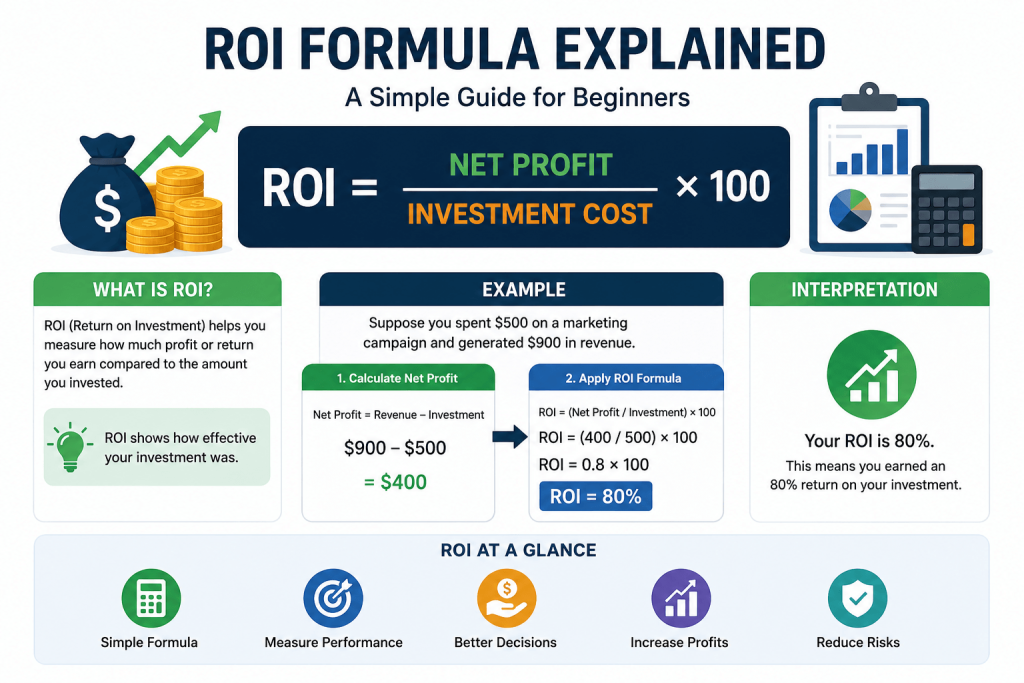
ROI = (Net Profit ÷ Investment Cost) × 100
This formula gives the result in percentage form.
Simple Breakdown
- Net Profit = Total revenue minus total investment
- Investment Cost = Total money invested
- Multiply by 100 = Converts the result into a percentage
The higher the ROI percentage, the better the investment performed.
ROI Formula Example
Let’s understand the ROI formula with a simple example.
Example
Suppose you spent:
- $500 on advertising
- Generated revenue: $900
Step 1 — Calculate Net Profit
Net Profit = Revenue – Investment
$900 – $500 = $400
Step 2 — Applying Formula
ROI = (400 ÷ 500) × 100
= 0.8 × 100
= 80%
Final Result
Your ROI is 80%.
This means you earned an 80% return on your investment.
Why ROI Is Important
ROI is one of the most important metrics in business and marketing because it helps people make smarter decisions.
Instead of guessing whether something is profitable, ROI provides clear numbers.
Businesses Use ROI For:
- marketing campaigns
- advertising performance
- investment analysis
- product launches
- business growth tracking
- freelancer project evaluation
Without ROI, businesses would struggle to understand which investments are successful.
How Marketers Use ROI
Digital marketers frequently calculate ROI to measure advertising performance.
For example:
- Google Ads
- Facebook Ads
- Instagram promotions
- SEO campaigns
- influencer marketing
If a company spends money on ads, ROI helps determine whether the campaign generated enough profit.
A positive ROI usually means the campaign performed well.
A negative ROI means the business lost money.
Positive ROI vs Negative ROI
Positive ROI
A positive ROI means:
- profit was generated
- the investment performed well
- revenue was higher than cost
Example:
- Spend: $1000
- Revenue: $1800
Result:
Positive ROI
Negative ROI
A negative ROI means:
- the investment lost money
- costs were higher than returns
Example:
- Spend: $1000
- Revenue: $700
Result:
Negative ROI
Businesses usually try to improve campaigns with low or negative ROI.
ROI in Small Businesses
Small businesses use ROI to:
- measure product profitability
- compare marketing campaigns
- analyze investments
- track business growth
For example, if a small business owner invests in advertising, they can calculate ROI to see whether the campaign increased sales.
This helps avoid wasting money on ineffective marketing strategies.
ROI in Freelancing
Freelancers also use ROI calculations.
For example:
- money spent on tools
- paid ads
- courses
- software subscriptions
Freelancers calculate ROI to understand whether their investments improve income or client growth.
Common ROI Mistakes
Many beginners make mistakes when calculating ROI.
Here are some common ones:
Ignoring Extra Costs
Some people only calculate basic costs and ignore:
- taxes
- software fees
- maintenance costs
- hidden expenses
This creates inaccurate ROI results.
Using Incorrect Revenue Numbers
Always use actual revenue instead of estimated income.
Wrong revenue data leads to incorrect ROI percentages.
Comparing Different Time Periods
Comparing short-term and long-term investments without context can be misleading.
For example:
- 1-month ROI
- 1-year ROI
should not always be compared directly.
ROI vs Profit
Many beginners confuse ROI with profit.
However, they are different.
Profit
Profit shows:
- how much money you earned
ROI
ROI shows:
- how efficiently your investment performed
Two businesses may have the same profit, but different ROI percentages depending on investment size.
ROI vs Profit Margin
Both are different metrics.
ROI
Measures:
- return compared to investment
Profit Margin
Measures:
- percentage of profit from total revenue
Both metrics are important for business analysis.
You can also use our Profit Margin Calculator to calculate profit margins easily.
How to Improve ROI
Businesses constantly try to improve ROI.
Some common methods include:
- reducing costs
- improving marketing performance
- increasing conversions
- targeting better audiences
- improving product quality
- optimizing advertising campaigns
Even small improvements can significantly increase ROI over time.
Using an ROI Calculator
Manual ROI calculations are simple, but online calculators save time and reduce mistakes.
Using an ROI Calculator allows you to:
- calculate results instantly
- avoid formula errors
- compare investments quickly
- improve decision-making
Our free ROI Calculator is designed for beginners, marketers, freelancers, and business owners.
FAQs
What does ROI stand for?
ROI stands for Return on Investment.
What is a good ROI percentage?
A good ROI depends on the industry and investment type. Generally, higher ROI percentages are better.
Can ROI be negative?
Yes. Negative ROI means the investment lost money.
Why is ROI important?
ROI helps businesses and individuals understand whether investments are profitable.
Is ROI used in marketing?
Yes. ROI is widely used in digital marketing to measure advertising and campaign performance.
Can small businesses use ROI?
Absolutely. Small businesses frequently use ROI to track profits and improve financial decisions.
Conclusion
The ROI formula is one of the most useful financial formulas for businesses, marketers, freelancers, and investors. It helps measure profitability and determine whether an investment was successful.
Once you understand how the ROI formula works, you can make smarter business and marketing decisions with confidence.
Whether you are running ads, investing money, or managing a small business, ROI calculations can help improve financial planning and performance.
To save time and calculate results instantly, you can use our free ROI Calculator online.
For Pakistan users you can use our Roi calculator for Pakistan