
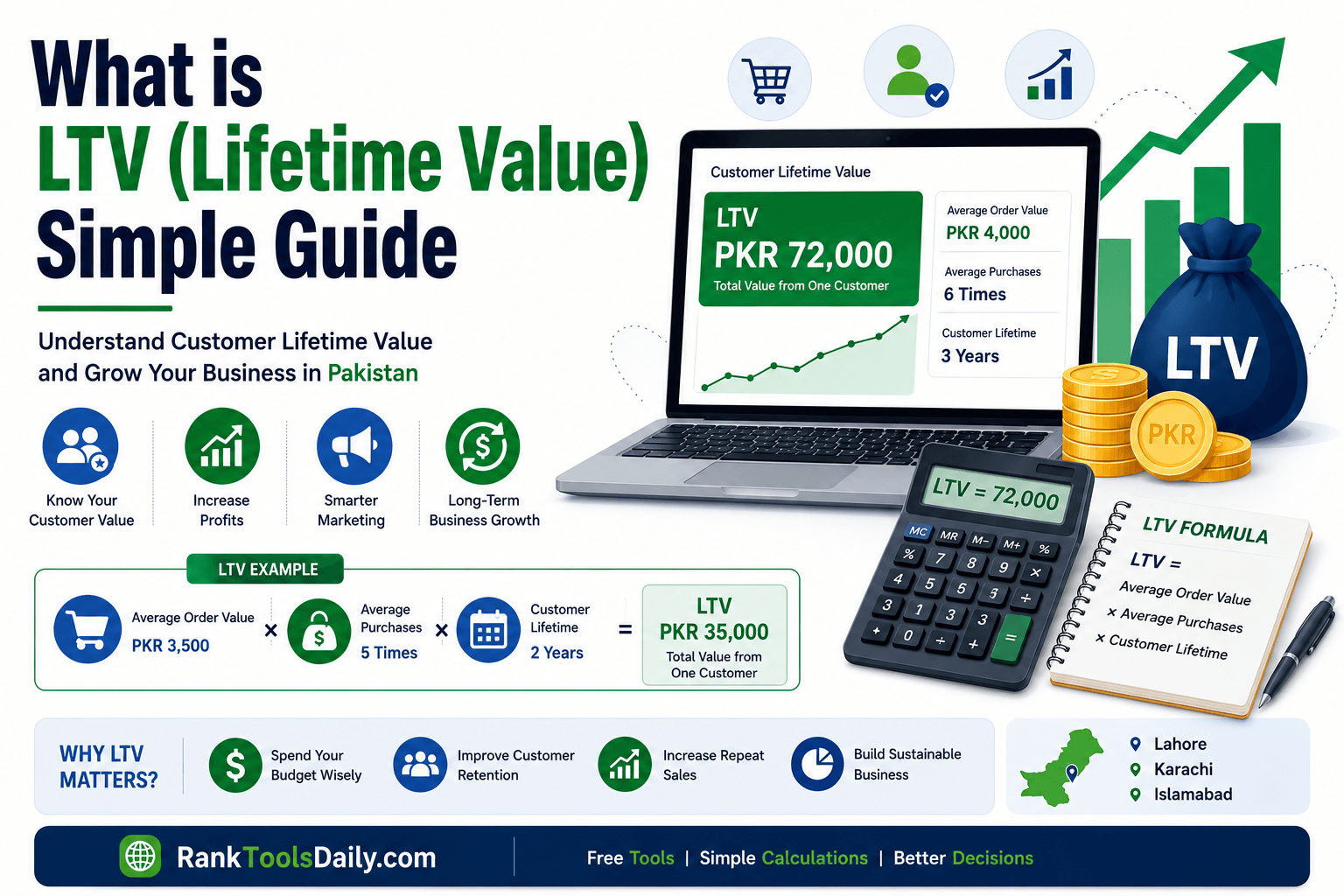
What is LTV (Lifetime Value) — Simple Guide
LTV, or Customer Lifetime Value, is a key metric in marketing and business that estimates the total revenue a customer will generate for a business throughout their entire relationship. It helps businesses understand the long-term value of their customers, guiding decisions related to marketing investments, customer acquisition, and retention strategies.
Understanding Customer Lifetime Value (LTV) is crucial for freelancers, online sellers, digital marketers, and small business owners in Pakistan. LTV helps you determine the total revenue a customer generates during their relationship with your business. This insight allows you to make informed marketing decisions by knowing how much you can invest in acquiring a new customer while maintaining profitability. It can guide budgeting for marketing campaigns and optimize customer retention strategies.
RankToolsDaily offers several free calculators to help freelancers, marketers, and business owners make better decisions.
In this beginner-friendly guide, you will learn what LTV means, why it matters, how to calculate it, and how to increase it using simple examples from Pakistan.
What is LTV (Lifetime Value)?
LTV stands for Lifetime Value, also called Customer Lifetime Value (CLV).
It is the total amount of revenue a customer generates before they stop buying from your business.
Instead of looking at one sale, LTV focuses on the customer’s complete journey.
Businesses with a higher LTV usually earn more profit because customers continue purchasing over time.
Why is LTV Important?
LTV helps businesses understand the long-term value of every customer.
Here are some benefits of tracking Lifetime Value.
Better Marketing Budget
If you know each customer brings high value, you can spend more on advertising confidently.
Higher Profits
Returning customers usually cost less than finding new ones.
Smarter Business Decisions
LTV helps you decide whether your marketing campaigns are profitable.
Business Growth
Companies in Lahore, Karachi, and Islamabad use LTV to improve customer retention and increase long-term revenue.
LTV Formula Explained
The basic formula is easy to understand.
LTV = Average Order Value × Average Purchases × Customer Lifetime
Example:
Average Order Value = PKR 4,000
Customer buys 6 times
Average customer stays for 3 years
LTV = 4,000 × 6 × 3
LTV = PKR 72,000
This means one customer is worth approximately PKR 72,000 during their relationship with your business.
LTV Example in Pakistan
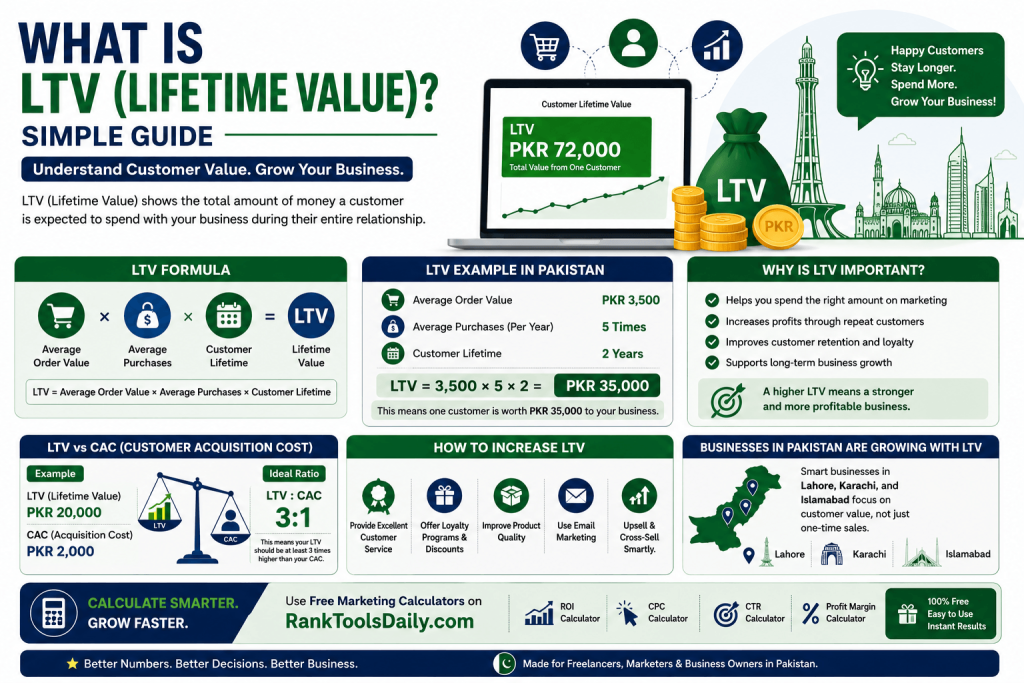
Suppose you own an online clothing store in Karachi.
Each customer spends PKR 3,500 on average.
They buy 5 times every year.
Most customers stay for 2 years.
LTV = 3,500 × 5 × 2
LTV = PKR 35,000
If your advertising cost to get one customer is only PKR 2,500, your business is making a healthy profit.
Learn more about Customer Lifetime Value (LTV) from the official Google Analytics Help documentation to better understand customer value and long-term business growth.
How to Increase Customer Lifetime Value
Improving LTV helps your business grow without constantly spending money on new customers.
Provide Excellent Customer Service
Happy customers are more likely to buy again.
Offer Loyalty Programs
Reward repeat customers with discounts or exclusive offers.
Improve Product Quality
Better products encourage repeat purchases.
Send Email Marketing Campaigns
Keep customers updated about new products and promotions.
Upsell and Cross-Sell
Recommend premium products or related items to increase average order value.
LTV vs Customer Acquisition Cost (CAC)
LTV works best when compared with Customer Acquisition Cost (CAC).
CAC tells you how much money you spend to acquire one customer.
If your LTV is much higher than your CAC, your business is healthy.
Example:
Customer Acquisition Cost = PKR 2,000
Customer Lifetime Value = PKR 20,000
This means every customer generates much more revenue than the amount spent to acquire them.
Most successful businesses aim for an LTV:CAC ratio of at least 3:1.
Common Mistakes When Calculating LTV
Many beginners calculate Lifetime Value incorrectly.
Avoid these mistakes.
- Ignoring repeat purchases.
- Forgetting subscription income.
- Using estimated values without tracking real sales.
- Not updating LTV regularly.
- Ignoring refunds and cancellations.
Using accurate business data gives more reliable results.
Use Free Marketing Calculators on RankToolsDaily
Understanding marketing metrics becomes much easier when you use the right tools.
RankToolsDaily offers several free calculators to help freelancers, marketers, and business owners make better decisions.
Popular tools include:
- ROI Calculator
- CTR Calculator
- CPC Calculator
- Profit Margin Calculator
These tools help you calculate profits, advertising costs, and campaign performance in just a few seconds.
Tips to Improve LTV in Pakistan
Businesses across Lahore, Karachi, and Islamabad can increase LTV by following these simple strategies.
- Build long-term relationships with customers.
- Respond quickly to customer questions.
- Offer personalized discounts.
- Create valuable content through blogs and social media.
- Improve delivery speed and customer support.
These small improvements often lead to higher repeat purchases.
Frequently Asked Questions (FAQs)
What is LTV in marketing?
LTV (Lifetime Value) is a metric that quantifies the total revenue a customer is expected to generate for a business throughout their entire relationship. It is an important indicator of customer profitability and helps businesses make informed decisions regarding marketing strategies and resource allocation.
Why is LTV important?
Understanding customer value is essential for businesses as it enables them to enhance profitability and make informed marketing decisions. By analyzing customer data and behavior, companies can identify what drives customer satisfaction and loyalty, leading to improved financial outcomes and targeted marketing strategies.
How do I calculate LTV?
Use this formula:
LTV = Average Order Value × Average Purchases × Customer Lifetime
What is a good LTV?
A higher LTV is generally better because it means customers continue buying from your business for a longer period.
Conclusion
LTV (Lifetime Value) is an important business metric used by freelancers, digital marketers, online sellers, and small business owners in Pakistan. It goes beyond evaluating a single sale and focuses on understanding the total value a customer brings to the business over their entire relationship. This metric aids in making informed decisions regarding customer acquisition, retention strategies, and overall business growth. By calculating LTV, businesses can better allocate resources and optimize their marketing efforts to enhance profitability.
Improving customer satisfaction can lead to increased repeat purchases, which in turn can enhance customer Lifetime Value (LTV) and boost profits over time. By integrating LTV with essential metrics such as Return on Investment (ROI), Cost Per Click (CPC), and Click-Through Rate (CTR), businesses can make informed marketing decisions that contribute to overall business growth and effectiveness.
Learn how to measure your marketing profits with our free ROI Calculator and make better business decisions in seconds.
Want to understand advertising costs? Read our guide on What is Cost Per Lead (CPL) and learn how businesses calculate lead generation expenses.
Improve your Google Ads performance by reading What is Quality Score in Google Ads Pakistan and discover how it affects CPC and ad rankings.
Use our Profit Margin Calculator to calculate business profits easily and compare them with your Customer Lifetime Value (LTV).